WHEN Americans think of German unification, they are apt to think only of joining together the East and West zones, split by the Iron Curtain. West Germans, however, even on their official maps, look beyond to a third Germany severed at Potsdam in 1945. At that time, Britain and the U.S. reluctantly agreed that Russia and Poland were entitled to territorial compensation at Germany’s expense. The final determination of Germany’s borders was to come later, in the Big Four Peace Conference that has never been held. At Potsdam, Russia annexed the northern half of East Prussia, including its ancient capital of Koenigsberg (now Kaliningrad). Poland took the rest of East Prussia and all German territory east of the Oder and Neisse rivers. An area the size of South Carolina, this included part of Brandenburg, most of Pomerania and all of German Silesia (coal, steel, potatoes). Millions of Germans were thrown out; Polish settlers moved in. The East German Communist government has been forced to sign away its claims on this territory, but West German Chancellor Adenauer has given notice that Germany will never accept the Oder-Neisse line as its eastern frontier. Thus Germany is the one European nation that is even more determined than the U.S. to roll back the Iron Curtain.
(West) Germany did end up accepting the Oder–Neisse line, by signing the Treaty of Moscow in 1970.
WHEN Americans think of German unification, they are apt to think only of joining together the East and West zones, split by the Iron Curtain. West Germans, however, even on their official maps, look beyond to a third Germany severed at Potsdam in 1945. At that time, Britain and the U.S. reluctantly agreed that Russia and Poland were entitled to territorial compensation at Germany’s expense. The final determination of Germany’s borders was to come later, in the Big Four Peace Conference that has never been held. At Potsdam, Russia annexed the northern half of East Prussia, including its ancient capital of Koenigsberg (now Kaliningrad). Poland took the rest of East Prussia and all German territory east of the Oder and Neisse rivers. An area the size of South Carolina, this included part of Brandenburg, most of Pomerania and all of German Silesia (coal, steel, potatoes). Millions of Germans were thrown out; Polish settlers moved in. The East German Communist government has been forced to sign away its claims on this territory, but West German Chancellor Adenauer has given notice that Germany will never accept the Oder-Neisse line as its eastern frontier. Thus Germany is the one European nation that is even more determined than the U.S. to roll back the Iron Curtain.
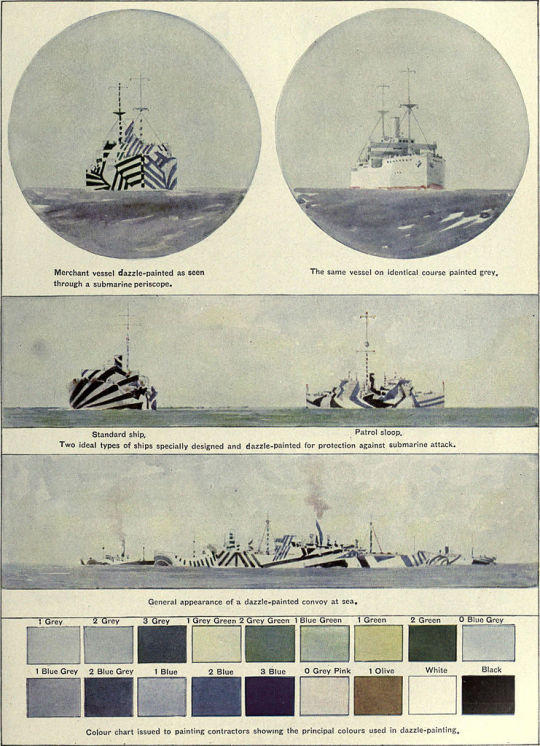
Also known as razzle dazzle, designed not to conceal ships from submarines, but to make the estimation of their speed, heading and range difficult, resulting, in theory, in a poor estimation of their position, and therefore, poor accuracy of any torpedo launched at them.
Implemented during World War 1 after its conception by the British artist Norman Wilkinson, but during its use it was never successfully proved as effective, or ineffective for that regard, and so by the start of World War 2 it had been effectively passed out for more conventional paint schemes.
Camouflage
Artifact from the secret cabinets of Catherine the Great. Commissioned by her lover Grigory Orlov.




 OrigineTblr