The internet went from showing food recipe videos to alchemy in less than a decade. There’s going to be a quick video on how to make the philosopher’s stone from tomato sauce next week.
(Image caption: Vvive la différence. In this case the difference is the position of the lips when making the “oo” sound, as in goose, in English and in French. Credit: Masapollo et. al.)
For all talkers, except perhaps the very best ventriloquists, the
production of speech is accompanied by visible facial movements. Because
speech is more than just sound, researchers set out to ascertain the
exact visual information people seek when distinguishing vowel sounds.
“An important and highly debated issue in our field concerns what is
it that we are attending to in speech — what’s the object of
perception?” said lead author Matthew Masapollo, who conducted the
research as a postdoctoral scholar at Brown University and is a now at
Boston University. “Another question that’s debated is whether speech
processing is special and distinct from other kinds of auditory
processing since it is not purely an acoustic signal.”
Resolving these questions would improve the scientific understanding
of how we perceive speech, Masapollo said. That, in turn, could apply to
the design of more intelligible online avatars and physical robots, and
could even improve computer recognition of human speech and enhance
communication devices for the hearing impaired.
While scads of studies have investigated which audible features of
speech are important, Masapollo said, far fewer have looked at which
visual components are essential, despite evidence from phenomena as
intuitive as lip reading that the sights of speech matter, too.
Through a series of experiments at Brown and McGill University in Montreal reported in the Journal of Experimental Psychology: Human Perception and Performance,
Masapollo and colleagues found that when people perceive speech, they
closely watch the form and motion of the lips. If either of those cues
is missing, their ability to make subtle distinctions between vowel
sounds suffers measurably.
“The findings demonstrate that adults are sensitive to the observable
shape and movement patterns that occur when a person talks,” said
Masapollo, who did the work as a researcher in the lab of senior author
James Morgan, a Brown professor of cognitive, linguistic and
psychological sciences.
Exploiting differences in speech perception
Earlier this year, Masapollo set the table for the new study when he
and co-authors Linda Polka and Lucie Ménard showed in the journal Cognition that people exhibit the same “directional asymmetry” in
visually perceiving vowels that they do when hearing vowels: They are
better at distinguishing between two versions of the “oo” sound, as in
the word “loose,” if the less extremely articulated version occurs first
and then the more extreme version second. If the order is switched,
they are much less likely to discriminate them — by sight or sound.
While these directional effects may seem like a quirky instinct, they
reflect a universal bias favoring vowels produced with extreme
articulatory maneuvers. Current research is focused on uncovering what
salient features or properties of extreme vowels give rise to these
perceptual asymmetries.
It turns out that this asymmetry plays out between French and
English, being manifest in the bilingual speech of many Canadians. When
speaking French, their articulation of “oo” is produced with more
visible lip protrusion and tongue positioning than when making the same
vowel sound in English.
For the new study, Masapollo realized that this asymmetry in vowel
production and perception provided a great opportunity to determine
which visual features matter in distinguishing subtle speech
differences. He devised and led five experiments to ferret out exactly
what visual information was pertinent to this asymmetry.
In the first, with help from Brown graduate student and co-author
Lauren Franklin, he employed eye-tracking technology to measure where
Brown student volunteers looked when watching videos of a bilingual
Canadian woman make “oo” sounds in both French and English.
Definitively, people watched the mouth, far more, for instance than the
eyes.
But what about the mouth mattered? To determine if motion, rather
than simply a particular position, was important, the next experiment
presented students with a still frame rather than video. In experiment
two, volunteers at McGill tried to distinguish “oo” speech using just
still images of the same speaker. Without the cue of motion, the results
showed, the asymmetry of French-English or English-French ordering no
longer occurred, suggesting that motion is a key component in this
instinct of vowel perception.
In the next three experiments, the team continued to investigate
which visual aspects of speech perception mattered among groups of Brown
or McGill student volunteers. In experiment three, the subjects saw not
a face, but an array of four dots in a diamond pattern that moved just
like the speaker’s lips did. When the speaker pursed her lips to make
the “oo,” the dots moved closer together, for example. Masapollo’s
hypothesis was that position and motion might matter together, even if
the face isn’t actually represented. In this experiment, people returned
to showing the asymmetry suggesting that he was on the right track.
(Image caption: Many methods. Researchers employed many visual representations of lip motion to see which essential features really mattered. Credit: Masapollo et. al.)
Experiment four was exactly the same but the dot pattern was rotated
45 degrees clockwise, showing more of a square than a diamond. Here the
asymmetry didn’t occur, suggesting that the orientation of the dots to
represent a speech-making mouth matter. In experiment five, the motion
was represented by a sideways figure eight that would move in a manner
analogous to the speaker’s lips. There, too, without even an essential
form of a mouth, people didn’t show their instinctual asymmetry of vowel
perception. Mere motion, without the form and position of a mouth, was
not enough.
“Overall, the picture that emerges is that perceptual asymmetries
appear to be elicited by optical stimuli that depict both lip motion and
configural information,” the authors wrote.
To Masapollo, the results demonstrate that vision makes specific contributions to perceiving speech.
“The findings of the present research suggest that the information we
are attending to in speech is multimodal, and perhaps gestural, in
nature,” Masapollo said. “Our perceptual system appears to treat
auditory and visual speech information similarly.”
We all love disaster movies! The cool special effects, the underdog stories, the underlying themes of hope. As cool as they are, they do tend to use misconceptions about natural disasters. This normally wouldn’t be an issue since Hollywood will always embellish but it’s important to know the true science behind these phenomena should you ever encounter them.
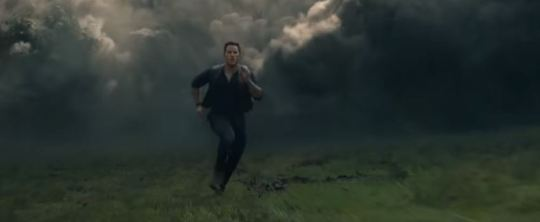
1) Pyroclastic flows will kill you almost instantly, you cannot survive a direct hit
Movies guilty of this: Jurassic World: Fallen Kingdom, Dante’s Peak
Pyroclastic flows exceed 100km/h and reach temperatures over 1,000°C. You definitely cannot outrun it in either car or on foot. The boiling hot toxic gas, ash, and lava in the flow will kill you instantly and pummel your smoking corpse into oblivion. Sorry, Chris Pratt.
2) Tsunamis do not crest, they are more like a sudden flood than a wave
Movies guilty of this: Literally any movie with a tsunami ever
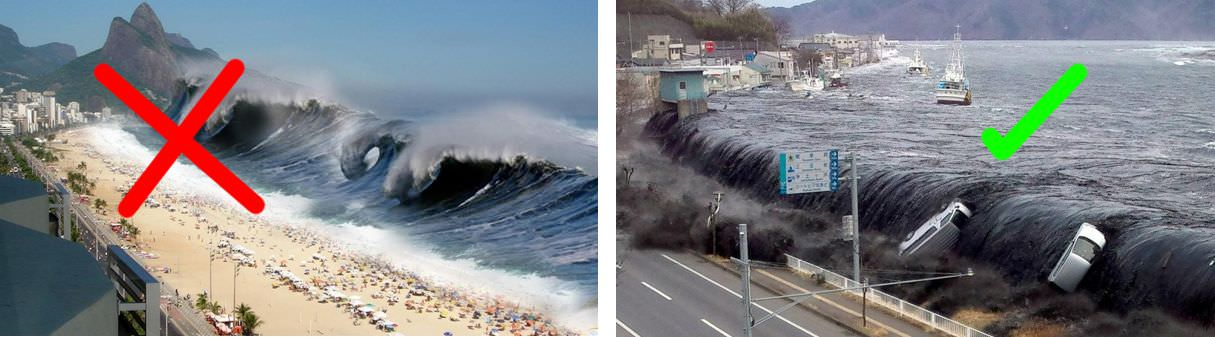
Tsunamis are massive and sudden floods caused by the displacement of ocean water due to earthquakes or massive landslides. They’re not tidal waves and thus do not crest. It’s poetic, but inaccurate.
3) Hail is always spherical and doesn’t fall in big cinder blocks of ice
Movies guilty of this:The Day After Tomorrow
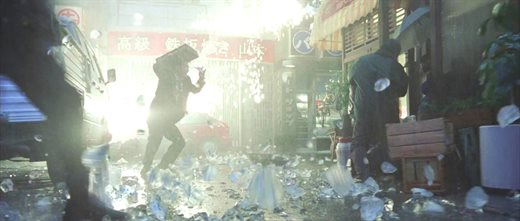
Hail can get quite large and can definitely be fatal, but they are exclusively spherical. Hail is formed by water droplets cycling through the updrafts of a thunderstorm and the rotational movements make the resulting hail a ball.
Looks more like a stage hand is throwing the remains of an ice swan than a hail storm
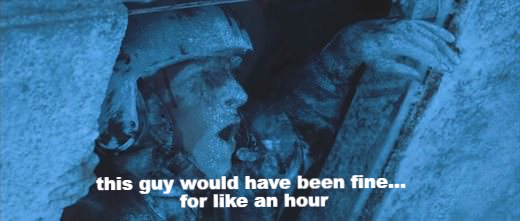
4) You cannot freeze instantaneously. Not even in space.
Movies guilty of this: The Day After Tomorrow, Geostorm, The Cloverfield Paradox, Sunshine
Space, and certain places on Earth, can get exceedingly cold. The coldest temperature ever recorded on Earth was −89.2 °C. That’s damn cold. But you still wouldn’t flash freeze into a peoplesicle within mere seconds. Intense cold can kill you quickly if you’re completely exposed but it would still take time before your body would be a thoroughly frozen chunk of meat. As for space, it can get quite cold, but it’s also an empty vacuum. There’s nothing around you but empty void, which means there’s also nothing to transfer your body heat away from you. Without convection, your body heat would be lost via radiation and that can take a long time.
5) Earthquakes over 10 on the Richter scale are physically impossible on Earth.
Movies guilty of this: 10.5
You would need a massive fault line to carry that sort of energy. Something on the scale of going through the earth’s core. Which does not exist . Even then, if such an earthquake would occur, the planet would literally explode.A 15 magnitude earthquake would release energy on the magnitude of 1×10^32 joules. That, coincidentally, is the same amount of energy contained in the gravitational binding of the Earth. Simply put, anything greater than 9.9 on the Richter scale is impossible and would cause the Earth to explode.
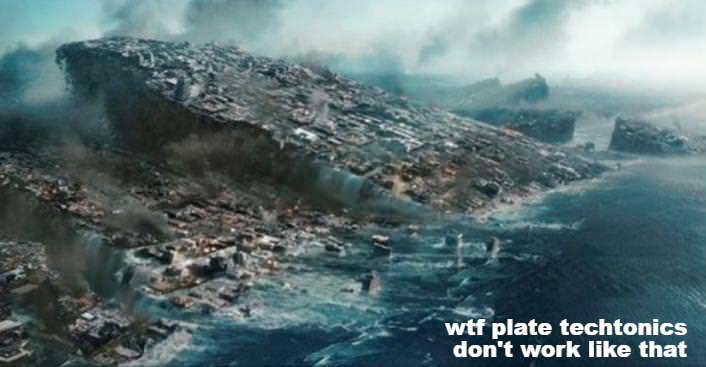
6) California will and can not sink into the Pacific like a big slab, and it can’t break away from the rest of the US.
Movies guilty of this: 2012, 10.5
Most movies cite the San Andreas fault as the reason for the cleavage, but even this isn’t enough. The San Andreas fault is a transform fault, meaning the North American plate and the Pacific Plate are slowly horizontally grinding past each other, not pushing away. As California is a part of the greater Pacific plate, it literally could not snap free from it to “sink into the sea”. Because if the entire tectonic plate underneath California where to flip over and sink then the entire ocean would drain away into the mantle.
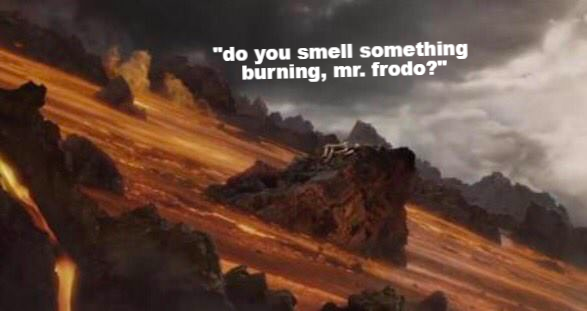
7) You can’t sink in lava. You also can’t stand near it without being burned.
Movies guilty of this: Volcano, Lord of the Rings: Return of the King
Lava is molten rock, and is incredibly dense. In fact, it’s three times as dense as humans, who are mostly water. If you were to cannonball into a lava pit, you would dip in a bit before bouncing to the top and floating. You would also burn up and die super quickly. Because fresh lava can exceed 1,200°C! Even standing a couple feet away from a lava flow, you would feel the intense heat radiation. You would lose your eyebrows and probably the top layer of your skin if you stood too close. There’s a reason why volcanologists wear protective suits. Sam and Frodo would have been roasted.




 OrigineTblr